It is hard to believe that the month of April is almost over. The days seem to be flying past, and it is like looking out a high-speed train window and watching the scenery blur past. Our weather here in the Midwest is finally becoming civilized. Yesterday, I actually had to turn on the air conditioner when it became an uncomfortable 79 degrees in the house. Yikes, what a creature of comfort I have become. Not to mention, what a blob of mushy muscleless fat has overtaken any muscle I had left. I should go into a discussion of weight loss here, but the subject bores me. Not only that, but thinking about weight loss only gives me a guilt trip.
Version 1.0.0
Right now, there is a fabulous race going on in nature. Who will win? The weeds or the flowers? A week ago, a friend offered me a contact who is willing to pull weeds for cash. I held up my hand saying that it was still too early to be pulling weeds. Here I am five days later ready to call him to go to work. I knew this would happen when I designed my garden which I labeled the Monet Vision. A very complicated densely planted annual garden takes a lot of maintenance. At that time, I still had the energy and flexibility to bend, kneel, and yank weeds. Today, it is a much different story. What amazes me is how quickly the body has adapted to sitting, and how quickly the muscles forget their duty. When I do finally get on my knees to do something, like pick up something that has fallen out of hand, It takes a front end loader to get me back up again. I am finally beginning to understand what my father always told us, “Don’t get old.” Mentally, I’m still twenty-five, but physically I may be around 110.
As a preteen, I admired old guys like my Gramps and his buddies. They were so cool. They sat under the shade of the giant willow tree while smoking, sippng a beer, and trying to outdo themselves with tales from the ‘Old Country.’ Now, I am the old guy, but I don’t smoke, and I don’t drink beer, and my old country is this country. Even worse, my grandkids are too far away from me to be telling them tall tales. At least I have the memories. I have however recorded many of my memories in a series of books under the title of Jun-e-or. The mistake I made was assuming that these kids would like to read. In today’s world if it isn’t a video they don’t seem to be interested. I’d love to make them into videos, but there isn’t enough time in a day to learn how to do that kind of stuff. I just hope they will find the time to read these stories to their grand children. I learned how to make videos’ back in 1968. Back then they were called movies. Taking super-eight movies was my passion and I even joined a movie club to help me learn how to make interesting films. I know what it takes to make films with interest. I converted some of my films to video and posted them on my Youtube channel. Search for Joseph Rohaly on youtube to find these gems. (see list below)
My biography won’t interest anyone, not even me. That is one reason I keep doing new things and learning new skills: in the hope that one day I’ll strike oil and offer the world something of value. With my luck, by the time I strike oil, the world will have been forced to electrify, and oil will be a dirty, slippery substance that no one will know what to do with.
I look forward to global warming. All my life, I have longed to live in a warmer climate without snow, ice, and blustery cold wind. According to sleepy Joe Biden, global warming is upon us, and I may be too late to enjoy it. The reality of that happening within this century is remote at best. Maybe if Earth experiences a hundred or more volcanic eruptions within a year, the temperature will rise. Except, there will be a period of global cooling after the eruptions. Earth will warm up. again, but no one will be around to know it is warmer because we will have all starved or froze to death during the cooling period.
Well, I have succeeded in ending this fantasy with the same lack of excitement as I had at the beginning, and It’s time to change chairs and find something more interesting to do.
One of my memories about the weather is from February in the nineteen forties. Similar to this year’s weather, we had an unusual February warmup. I was still in grammar school, probably the fourth grade. Back then we had recess at mid-morning and we were let loose to run off steam for fifteen minutes. Because it was February, we had winter coats, hats mittens, scarves and boots. By lunch time. when we had an hour off, the temperature was in the seventies. Most kids removed their coats and left them on the ground until the bell rang to come in. Being a good son, I heeded Mother’s orders to leave my coat on. Playing tag while wearing a winter coat during a seventy degree day was a sweating experience. Sis and I were the only ones in the entire school yard with coats on.
I remember this because today, 8 February 2024, the temperature is expected to reach fifty-five degrees. A far degree from seventy but no less unusually warm. I expect the sirens of global warming to be singing in the breeze and on TV news: “The warm weather we now experience is due to man-made global warming; go out and buy an electric car today.”
Mother was a stickler for staying healthy. She blamed all childhood illnesses on winter weather. Her advice was never to go outside without a coat on in any month that has the letter “R” in it. That left us with May, June, July, and August to enjoy the weather without wearing a coat. Strange that those four months happen to coincide with the Summer season. Never mind that during any of those months the temperature can drop by thirty degrees within an hour making one wish for a coat to wear. Another of her favorite admonitions was, “never sit on the bare concrete in months containing the letter “R”.
Global weather patterns exist twenty-four hours a day, seven days a week, and three hundred sixty-five days a year and have been changing regularly in cycles controlled by the sun’s activity. How can that be? You ask? The sun is ninety-three million miles away from Earth. Yet, my friends the sun has an enormous effect on our weather patterns. A single solar flare can disrupt our electronics in ways we fail to imagine. The sun is just a mammoth ball of fire being fueled by gasses coming from it’s core. One large pocket of gas being expelled from an inner chamber will cause a flare that sends a ball of energy speeding through the universe that changes many things on our planet and all the others in our Solar System. ( A more picturesque way to explain this phenom is a bit crass but very graphic: Liken a solar flare to a human fart. It has an effect on those nearby.”
That said, on a wintery day in February, it is time to put on a light coat and go for a walk.
The push to electrify the world is based on the premise that we are causing global warming by burning fossil fuels, which produce carbon dioxide. Carbon dioxide in the air makes the air get hotter than what is normal. This warming is then causing the polar ice caps to melt and the oceans to rise. A lot of ice is stored around the planet in glaciers, ice mountains in Antarctica, and just plain ice in and around the north and south poles. One day soon, I will attempt to calculate the volume of ice that has to melt and determine how much the oceans rise to cover seventy percent of Earth. That is a lot of water. My logic urges me to believe there must be some warehouse full of ice that we don’t know about.
Anyway, I’ll get to my point. I believe that we should change our way of thinking a little bit. A scientist would say we should shift the paradigm. Let us assume that global warming is taking place. For the moment, forget about the BS that you are causing the warming by driving to the grocery store. Assume, instead, that in addition to your hot drive to get groceries, the Earth is in one of its normal warming cycles when the sun is flaring extra heavy, the Earth’s orbit is just a fraction smaller, bringing the planet an inch or two closer to the sun. At the same time, our planet begins spewing lava from its core in places like Yellowstone Park, the ring of fire encircling the Pacific Ocean, our fiftieth state, Hawaii, and all the other volcanoes scattered about the planet in places too numerous to enumerate. All of them spewing molten lava at temperatures between 1300 to 2400 degrees Fahrenheit. Compare that to our hot cars emitting carbon dioxide at a measly 400 to 500 degrees Fahrenheit. Scientists have yet to measure any atmospheric temperature of more than 0.000001 degrees, which is well within the measurement error. In other words, they have yet to see a measurable change. I point out that volcanoes have a much larger effect on global warming than cars.
Okay, we will assume that global warming will melt the ice caps, and the water level will rise by 230 feet. Not all the land people live on will be affected by that much water rise. True, the amount of land above water will be reduced, but there will be sufficient land above water to provide a home for Earthlings. Some scientists predict it will take five thousand years of regular global warming to melt all the ice on Earth. I, for one, will not see that happen, nor will any of my kids. But for those worried about that happening, what are you doing about the problem? For one, you are making radical changes that don’t make sense to change the temperature by some immeasurable fraction of a degree to slow it down. If this is a regular warming cycle, we don’t have a Chinaman’s chance in hell to change things. The world has been covered in ice many times before and uncovered in periods long before the internal combustion engine was invented. It will take something more drastic than changing the world to electric cars to make a noticeable change.
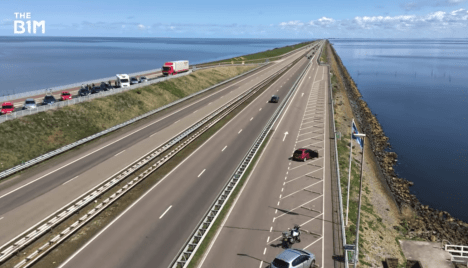
A Mechanical Sea Wall in the NetherlandsA Sea Wall Separating the North Sea From and Inland Lake
Here are some things we could be doing:
1. Build sea walls in places where it is feasible. The country of Holland has had a sea wall retaining the North Sea for centuries. Learn from the city of Venice, which deals with tidal sea rises in their city seasonally.
2. Plan new cities into which major populations can move.
3. Build new roads into these new cities.
4. Innovate new boat cities that will survive, and thrive in the flooded areas.
5. Learn how to survive with dikes and sea walls from the Netherlands.
6. Build seawalls to keep the coastline from invading the shore.
7. Build desalinization plants that can bring fresh water to desert areas.
8. Learn to grow food in less space than we use now.
9. Provide housing with smaller footprints to house more people in the same space.
10. Finally, learn that electricity and water don’t mix.
Instead of trying to make a common sense practical plan, we are wasting money and effort on stupid plans to electrify our transportation system and to transport everyone (most likely the elite among us) to Mars to escape the rising water. We have 5000 years to make it happen so if you are really worried get it started today!
Polar bear (Ursus maritimus) with cubs in the Wapusk National Park, Churchill, Manitoba, Canada
The government will have to be involved in any plan this big, so I recommend we stop wasting our time trying to keep Donald Trump from becoming president. Instead, we should abolish Black Lives Matter, because all lives matter. Abandon “Defund the Police, because we need to recognize that our society needs to be secure from the crazies among us. Recognize that being “Woke” only means we treat people of all races equally. Write to your Congressman to ask AI to give us the solution. Put all uber-liberal communists to work building the wall. In fact, I think it might be wise to put all of Congress to work building the seawall around the Capital to protect Washington, D.C., from being overwhelmed by the Potomac River. (Most likely, this seawall will be the first built; God forbid our government should be exposed to a life-threatening situation).
Lastly, write to your Congressman to ask what he plans to do about the sea rising from global warming.
Back when I was a kid I heard a story about a band of robbers who lived in a place called Sherwood Forest. The uniqueness of this band is that they didn’t rob to enrich themselves, and they didn’t rob from their fellow man. By now you know I am speaking of Robin Hood who became famous for robbing the rich to give to the poor.
There are many variations of this story developed by imaginative authors, and Hollywood movie makers but the origins were as I described. The story emanated from folk ballads sung in the 1300-1400-‘s. No one is left to explain what the real story is, but it doesn’t matter. Robbing the rich to feed the poor has been a mythical storyline that resonates with most folks. Robbing the rich to feed the poor is also the platform for early democrat, liberal, progressive peoples who need a way to make a living.
Fast forward to 2023. In today’s world I can relate Robin Hood to the Democrat party, and the Rich to the Republicans. Aside from the fact that in the year 1400 there were no defined political parties and the king owned everything. In today’s scenario the whole Rob the Rich to Feed the Poor philosophy has shifted. Currently the theme is to “rob the poor and enrich the rich.”
I experienced the phenomenon first hand again this afternoon as Lovely and I went shopping for sustenance. We came home with a small basketful of groceries and a bill for $204.67. Thank you Joe Biden from Sherwood Forest and your band of progressive bandits. I am waiting to see the account of how you have helped the poor with this massive spending. Instead I can see the effect on the rich who seem to be bubbling to the surface with government money intended to assist COVID strapped businesses. We also see how so many poor businesses, i.e the small guys who couldn’t make it have closed, gone forever.
I have consciously kept from speaking out against our current administration, but now I have experienced his Green New Deal reaching deep into my pockets. I will be vindicated someday, and my stance on the man-made global warming bullshit is just that, an excuse to steal from the poor to enrich the rich.
Truth be known, if every country in the world reduced it’s carbon emissions to below what they were a hundred years ago global warming might still take place. How will you bastards explain the hardship you put billions of people through to reach your taxing goal? The problem is that the poor people whom you so anxiously liberate from any riches will have evolved into the brow beaten zombies that you wish to rule. I predict a new generation of Robin Hoods will appear on the scene to start the cycle all over again. Instead of Kings there will be fat cats known as progressives who will crack the whip over your poor backs in the name of equality, and “you will love it.” Robin Hood will quickly gain steam from his exploits of robbing the fats cats to give back to the poor.
When I saw the title of this lecture, especially with the picture of the scantily clad model, I couldn’t resist attending. The packed auditorium was abuzz with questions about the address; nobody seemed to know what to expect. The only hint was a large aluminum block sitting on a sturdy table on the stage.
When the crowd settled down, a scholarly-looking man walked out and put his hand on the shiny block, “Good evening,” he said, “I am here to introduce NMC532-X,” and he patted the block, “we call him NM for short,” and the man smiled proudly.
“NM is a typical electric vehicle (EV) car battery in every way except one; we programmed him to send signals of the internal movements of his electrons when charging, discharging, and in several other conditions. We wanted to know what it feels like to be a battery. We don’t know how it happened, but NM began to talk after we downloaded the program.
Despite this ability, we put him in a car for a year and then asked him if he’d like to do presentations about batteries. He readily agreed on the condition he could say whatever he wanted. We thought that was fine, and so, without further ado, I’ll turn the floor over to NM,” the man turned and walked off the stage.
“Good evening,” NM said. He had a slightly affected accent, and when he spoke, he lit up in different colors. “That cheeky woman on the marquee was my idea,” he said. “Were she not there, along with ‘naked’ in the title, I’d likely be speaking to an empty auditorium! I also had them add ‘shocking’ because it’s a favorite word amongst us batteries.” He flashed a light blue color as he laughed.
“Sorry,” NM giggled then continued, “Three days ago, at the start of my last lecture, three people walked out. I suppose they were disappointed there would be no dancing girls. But here is what I noticed about them. One was wearing a battery-powered hearing aid, one tapped on his battery-powered cell phone as he left, and a third got into his car, which would not start without a battery. So I’d like you to think about your day for a moment; how many batteries do you rely on?”
He paused for a full minute which gave us time to count our batteries. Then he went on, “Now, it is not elementary to ask, ‘What is a battery?’ I think Tesla said it best when they called us Energy Storage Systems. That’s important. We do not make electricity – we store electricity produced elsewhere, primarily by coal, uranium, natural gas-powered plants, or diesel-fueled generators.
“So, to say an EV is a zero-emission vehicle is not at all valid. Also, since forty percent of the electricity generated in the U.S. is from coal-fired plants, it follows that forty percent of the EVs on the road are coal-powered, n’est-ce pas?” (French language for “isn’t it so.”)
He flashed blue again. “Einstein’s formula, E=MC2, tells us it takes the same amount of energy to move a five thousand pound gasoline-driven automobile a mile as it does an electric one. The only question again is what produces the power? To reiterate, it does not come from the battery; the battery is only the storage device, like a gas tank in a car.”
He lit up red when he said that, and I sensed he was smiling. Then he continued in blue and orange. “Mr. Elkay introduced me as NMC532. If I were the battery from your computer mouse, Elkay would introduce me as double-A, if from your cell phone as CR2032, and so on. We batteries all have the same name depending on our design. By the way, the ‘X’ in my name stands for ‘experimental.’
There are two orders of batteries, rechargeable, and single-use. The most common single-use batteries are A, AA, AAA, C, D. 9V, and lantern types. Those dry-cell species use zinc, manganese, lithium, silver oxide, or zinc and carbon to store electricity chemically. Please note they all contain toxic, heavy metals.
Rechargeable batteries differ only in their internal materials, usually lithium-ion, nickel-metal oxide, and nickel-cadmium.
The United States uses three billion of these two battery types a year, and most are not recycled; they end up in landfills. California is the only state which requires all batteries be recycled. If you throw your small, used batteries in the trash, here is what happens to them.
All batteries are self-discharging. That means even when not in use, they leak tiny amounts of energy. You have likely ruined a flashlight or two from an old ruptured battery. When a battery runs down and can no longer power a toy or light, you think of it as dead; well, it is not. It continues to leak small amounts of electricity.
As the chemicals inside it run out, pressure builds inside the battery’s metal casing, and eventually, it cracks. The metals left inside then ooze out. The ooze in your ruined flashlight is toxic, and so is the ooze that will inevitably leak from every battery in a landfill. All batteries eventually rupture; it just takes rechargeable batteries longer to end up in the landfill.
In addition to dry cell batteries, there are also wet cell ones used in automobiles, boats, and motorcycles. The good thing about those is, ninety percent of them are recycled. Unfortunately, we do not yet know how to recycle batteries like me, or care to dispose of single-use ones properly.
But that is not half of it. For those of you excited about electric cars and a green revolution, I want you to take a closer look at batteries and also windmills and solar panels. These three technologies share what we call “environmentally destructive embedded costs.”
NM got redder as he spoke. “Everything manufactured has two costs associated with it, embedded costs and operating costs. I will explain embedded costs using a can of baked beans as my subject.
In this scenario, baked beans are on sale, so you jump in your car and head for the grocery store. Sure enough, there they are on the shelf for $1.75 a can. As you head to the checkout, you begin to think about the embedded costs in the can of beans.
The first cost is the diesel fuel the farmer used to plow the field, till the ground, harvest the beans, and transport them to the food processor. Not only is his diesel fuel an embedded cost, so are the costs to build the tractors, combines, and trucks. In addition, the farmer might use a nitrogen fertilizer made from natural gas.
Next is the energy costs of cooking the beans, heating the building, transporting the workers, and paying for the vast amounts of electricity used to run the plant. The steel can holding the beans is also an embedded cost. Making the steel can requires mining taconite, shipping it by boat, extracting the iron, placing it in a coal-fired blast furnace, and adding carbon. Then it’s back on another truck to take the beans to the grocery store. Finally, add in the cost of the gasoline for your car.
But wait — can you guess one of the highest but rarely acknowledged embedded costs? NM said, then gave us about thirty seconds to make our guesses. Then he flashed his lights and said, “It’s the depreciation on the 5,000 pound car you used to transport one pound of canned beans!”
NM took on a golden glow, and I thought he might have winked. He said, “But that can of beans is nothing compared to me! I am hundreds of times more complicated. My embedded costs not only come in the form of energy use; they come as environmental destruction, pollution, disease, child labor, and the inability to be recycled.”
He paused, “I weigh one thousand pounds, and as you see, I am about the size of a travel trunk.” NM’s lights showed he was serious. “I contain twenty-five pounds of lithium, sixty pounds of nickel, 44 pounds of manganese, 30 pounds cobalt, 200 pounds of copper, and 400 pounds of aluminum, steel, and plastic. Inside me are 6,831 individual lithium-ion cells.
It should concern you that all those toxic components come from mining. For instance, to manufacture each auto battery like me, you must process 25,000 pounds of brine for the lithium, 30,000 pounds of ore for the cobalt, 5,000 pounds of ore for the nickel, and 25,000 pounds of ore for copper. All told, you dig up 500,000 pounds of the earth’s crust for just — one — battery.”
He let that one sink in, then added, “I mentioned disease and child labor a moment ago. Here’s why. Sixty-eight percent of the world’s cobalt, a significant part of a battery, comes from the Congo. Their mines have no pollution controls and they employ children who die from handling this toxic material. Should we factor in these diseased kids as part of the cost of driving an electric car?”
NM’s red and orange light made it look like he was on fire. “Finally,” he said, “I’d like to leave you with these thoughts. California is building the largest battery in the world near San Francisco, and they intend to power it from solar panels and windmills. They claim this is the ultimate in being ‘green,’ but it is not! This construction project is creating an environmental disaster. Let me tell you why.
The main problem with solar arrays is the chemicals needed to process silicate into the silicon used in the panels. To make pure enough silicon requires processing it with hydrochloric acid, sulfuric acid, nitric acid, hydrogen fluoride, trichloroethane, and acetone. In addition, they also need gallium, arsenide, copper-indium-gallium- diselenide, and cadmium-telluride, which also are highly toxic. Silicon dust is a hazard to the workers, and the panels cannot be recycled.
Windmills are the ultimate in embedded costs and environmental destruction. Each weighs 1,688 tons (the equivalent of 23 houses) and contains 1,300 tons of concrete, 295 tons of steel, 48 tons of iron, 24 tons of fiberglass, and the hard-to-extract rare earths neodymium, praseodymium, and dysprosium. Each blade weighs 81,000 pounds and will last 15 to 20 years, at which time it must be replaced. We cannot recycle used blades. Sadly, both solar arrays and windmills kill birds, bats, sea life, and migratory insects.
NM lights dimmed, and he quietly said, “There may be a place for these technologies, but you must look beyond the myth of zero emissions. I predict EVs and windmills will be abandoned once the embedded environmental costs of making and replacing them become apparent. I’m trying to do my part with these lectures.
Thank you for your attention, good night, and good luck.” NM’s lights went out, and he was quiet, like a regular battery.
* * *
The format is stupid, but the info is right on target. If you want to inflict maximum damage on the environment, you support EVs, wind turbines and solar panels – all with their associated batteries. They don’t even come close in being as environmentally clean as coal, natural gas, and nuclear power. Likewise, their (EVs, WTs, and Solar) cost is going to be exorbitant. WTs and Solar reliability is poor.
Electric vehicles are taxpayer subsidized for the purchase of each hybrid or fully electric vehicle with a discount of about $7,000. Then, the government does not collect road-use taxes. Further, the new infrastructure bill provides several billion dollars of taxpayer funds to build charging stations. Do we really want our Government in the “electric filling-station” business?
This is exactly what all these self-proclaimed, highly educated, intellectual, “ECO Nazi-es” need to read.
Never mind, they’re too intellectually deficient to comprehend how intertwined this information is with the damage being inflicted on our earth’s environment thanks to their “Green New Deal”