A Late Start

During my college days, I studied to become an engineer. The entire curriculum was steeped in math. One subject, in particular, used excessive mathematics, and that was Physics. The subject was so large that it was broken into three parts, each one semester long. My interest was in mechanics, and I was adept at the math involved in solving problems involving mechanical machines. I began to lose it when we reached nuclear physics, especially astronomy. Atomic physics was still on the cusp of discovery and development, so I wrote it off as something I could blow off because I would never use the knowledge to make a living, which was wrong. One project we worked on was developing a cable tie for nuclear power plants, specifically in the reactor exposed to heavy radiation.

Dresden Nuclear Power Plant 1960, Illinois

Somehow, I managed to eke my way through those subjects with a passing grade. In the above-mentioned radiation-resistant product, we designed and produced a successful cable tie and had it certified by the nuclear power industry. We invented and conducted a series of tests on our product to prove its efficacy in the reactor. It took two years and a lot of effort to do this. Then our competitors came along and talked the approvers into approving their products merely by showing they used the same material as we did. Thank you, Uncle Sam, for stealing our work and giving it to all of our competition.

What I find strange is that throughout my career, I used every bit of knowledge taught in my engineering courses. Whenever I counseled high school kids about engineering, I emphasized the importance of studying every course being taught in their syllabus because somewhere along the way, they will be called upon to use all—that useless stuff they were forced to learn. Even today, I am amazed that conversing with friends and peers helps to have a deep knowledge base. Except that I am deficient in atomic physics and astronomy. To offset this deficiency, I am now, at a ripe old age, finding intense interest in all things space. The Hubble and Webb telescopes have allowed astrologists to learn more about the nature of the universe in twenty years than man has known since the beginning of time. Remember when the argument was about the Earth being the center of the universe?

!960’s telescopic photo of Mars

I have read many articles about the universe and learned I am sixty years behind in the terminology. The space age and our drive to put a man on the moon have forced us to invent new terms and ways to express time and distance units. I left school at a time when the term “Light Year” was little used. Since then, physics has expanded the study to include the universe beyond our solar system, and the distances between stars and planets are so huge that even Light Year is too small to express the distances between stars and galaxies. An example is the unit AU, or Astronomical Unit, which defines the distance between the sun and the planets of our solar system. The AU of Earth is one. The AU of planets closer to the sun is smaller, and those beyond Earth are larger. It is easier to say or write the Earth is 1 AU away from the Sun than the Earth is 93,000,000(million) miles from the Sun. Another example of the system’s simplicity is that planet Neptune is 30 AU from the Sun instead of having to write Neptune is 2,795,580,000(billion) miles from the Sun.

Every day, I use a GPS in my car to locate and navigate to places I want to get to. Imagine traveling into space in a rocket ship, and you are flying above the Earth’s GPS. One needs a new and more expansive way to navigate. Modern space travel has already invented the system but relies on heady technology to make things happen. Remember when Columbus and Magellan traveled by boat to explore the vast, unknown expanse of planet Earth? You can’t follow the coastline like they did when you were exploring the universe. I wish I were young enough to start from scratch to learn all the new stuff I would need to explore and find new civilizations around space.

Although I like studying astronomy, I am still trying to understand the new language I must learn. I know I became obsolete as an engineer when I became a manager, and I never became proficient in using a computer to design products. I am from the pencil and paper age. However, I can still free-hand draw a three-D product as well as anyone using a computer. I can’t translate the geometry into machine tool instructions into a Numerical Controlled machine tool to cut a mold cavity like a computer-generated geometric model can. Imagine my degree of obsolescence in astronomy, where it is a struggle to become conversant.

Where will we be one hundred years from now?

Exploring new planets?

Living on a colony on Mars or the moon?

Trying to get the Muslims to accept the Jews?

Learning how to live off the grid after destroying the planet and mankind?

Living in underwater cocoons and eating seaweed because man forced the polar ice caps to melt.

James Webb Space Telescope
James Webb first image

James Webb-2022 Mars

The Sea Is Rising To Meet Us

The push to electrify the world is based on the premise that we are causing global warming by burning fossil fuels, which produce carbon dioxide. Carbon dioxide in the air makes the air get hotter than what is normal. This warming is then causing the polar ice caps to melt and the oceans to rise. A lot of ice is stored around the planet in glaciers, ice mountains in Antarctica, and just plain ice in and around the north and south poles. One day soon, I will attempt to calculate the volume of ice that has to melt and determine how much the oceans rise to cover seventy percent of Earth. That is a lot of water. My logic urges me to believe there must be some warehouse full of ice that we don’t know about.

Anyway, I’ll get to my point. I believe that we should change our way of thinking a little bit. A scientist would say we should shift the paradigm. Let us assume that global warming is taking place. For the moment, forget about the BS that you are causing the warming by driving to the grocery store. Assume, instead, that in addition to your hot drive to get groceries, the Earth is in one of its normal warming cycles when the sun is flaring extra heavy, the Earth’s orbit is just a fraction smaller, bringing the planet an inch or two closer to the sun. At the same time, our planet begins spewing lava from its core in places like Yellowstone Park, the ring of fire encircling the Pacific Ocean, our fiftieth state, Hawaii, and all the other volcanoes scattered about the planet in places too numerous to enumerate. All of them spewing molten lava at temperatures between 1300 to 2400 degrees Fahrenheit. Compare that to our hot cars emitting carbon dioxide at a measly 400 to 500 degrees Fahrenheit. Scientists have yet to measure any atmospheric temperature of more than 0.000001 degrees, which is well within the measurement error. In other words, they have yet to see a measurable change. I point out that volcanoes have a much larger effect on global warming than cars.

Okay, we will assume that global warming will melt the ice caps, and the water level will rise by 230 feet. Not all the land people live on will be affected by that much water rise. True, the amount of land above water will be reduced, but there will be sufficient land above water to provide a home for Earthlings. Some scientists predict it will take five thousand years of regular global warming to melt all the ice on Earth. I, for one, will not see that happen, nor will any of my kids. But for those worried about that happening, what are you doing about the problem? For one, you are making radical changes that don’t make sense to change the temperature by some immeasurable fraction of a degree to slow it down. If this is a regular warming cycle, we don’t have a Chinaman’s chance in hell to change things. The world has been covered in ice many times before and uncovered in periods long before the internal combustion engine was invented. It will take something more drastic than changing the world to electric cars to make a noticeable change.

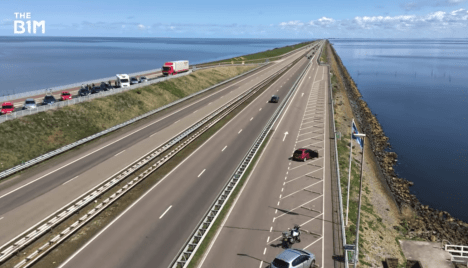
A Mechanical Sea Wall in the Netherlands
A Sea Wall Separating the North Sea From and Inland Lake

Here are some things we could be doing:

1. Build sea walls in places where it is feasible. The country of Holland has had a sea wall retaining the North Sea for centuries. Learn from the city of Venice, which deals with tidal sea rises in their city seasonally.

2. Plan new cities into which major populations can move.

3. Build new roads into these new cities.

4. Innovate new boat cities that will survive, and thrive in the flooded areas.

5. Learn how to survive with dikes and sea walls from the Netherlands.

6. Build seawalls to keep the coastline from invading the shore.

7. Build desalinization plants that can bring fresh water to desert areas.

8. Learn to grow food in less space than we use now.

9. Provide housing with smaller footprints to house more people in the same space.

10. Finally, learn that electricity and water don’t mix.

Instead of trying to make a common sense practical plan, we are wasting money and effort on stupid plans to electrify our transportation system and to transport everyone (most likely the elite among us) to Mars to escape the rising water. We have 5000 years to make it happen so if you are really worried get it started today!

Polar bear (Ursus maritimus) with cubs in the Wapusk National Park, Churchill, Manitoba, Canada

The government will have to be involved in any plan this big, so I recommend we stop wasting our time trying to keep Donald Trump from becoming president. Instead, we should abolish Black Lives Matter, because all lives matter. Abandon “Defund the Police, because we need to recognize that our society needs to be secure from the crazies among us. Recognize that being “Woke” only means we treat people of all races equally. Write to your Congressman to ask AI to give us the solution. Put all uber-liberal communists to work building the wall. In fact, I think it might be wise to put all of Congress to work building the seawall around the Capital to protect Washington, D.C., from being overwhelmed by the Potomac River. (Most likely, this seawall will be the first built; God forbid our government should be exposed to a life-threatening situation).

Lastly, write to your Congressman to ask what he plans to do about the sea rising from global warming.

Progress Report

It is week two of installing and learning the ins and outs of my new computer, and I realize that I will not live long enough to learn it all. Between the iPhone, iMac, and all the supporting programs that make the machine useful to me I’ve lost my voice from screaming at them.

I began using a Grammarly program to punctuate better and write more clearly. It needed an update. I did the update, but it bonged me because the Word program I use also required updating. Excuse me? I clicked the link to take me there without any other recourse but to update Word. It is good that Bill Gates no longer works there and lives in a very private place with tons of security because I would be convicted of murder if he wasn’t protected. Why? I’ll tell you. Since I have regularly had to update my Word 365 program, I mistakenly clicked on re-register instead of as a new customer. Then, the fun began. I got into a circular argument about my wrong password or username. I chased and chased using every user name I usually use with every password I have ever used with Microsoft, and all of them failed. All I want to do is give you money for the privilege of using your valuable knowledge, and you give me shit about my passwords! Thank God, Lovely called me to have dinner. I left the room and did not return until this morning. The first thing on my list was to update my Word program so I could then update my brand new Grammarly program and maybe do something productive.

I went to Microsoft directly and used their online order system this time. I defied them by claiming to be a new customer, thinking their AI would treat me more kindly. It worked. I went through as a new customer using my old username without a password. One difference from yesterday was they quoted 69 dollars for WORD 365, but today it was $79.

My future is uncertain, as I look forward to learning how Microsoft has cleverly hidden all of its standard features behind new buttons on new pages to do the same old things. Only then will I finally be able to update Grammarly and attempt to master the wizardly world of English grammar as presented by Grammarly AI.

Technology is Good?

Finally, after more than a week, I have my new computer working to a degree. No doubt, it will take me the rest of my lifetime to figure it out. Strangely, it has the same look and feel as the Iphone I use. That of course is purposeful. More people than ever are using their phones to do all of their business. My problem with computers is crime. The computer age has developed a new form of crime associated with people using them to do their personal business, and even their work related business. I am not one of those. It seems my work life came to an end about twenty years ago when the pocket computer age began ramping up.

Stand Your Ground: What if I shot my computer? | Cutler Bay Community News#

My biggest problem with understanding the new PC’s is the need for passwords. It won’t be long before we will need passwords between every word we type. Although I understand the need for password protection, I personally feel the companies are going about implementing security in the wrong direction. Instead of having to issue new usernames and passwords for each device and every new application you choose to use, the gurus of silicone should learn to use their own technology, so endearingly titled Artificial Intelligence, as a vehicle for keeping criminals out of our computers. Or, maybe they can’t do that because the Artifical Intelligence they so proudly proclaim will take over the world isn’t so intelligent after all.

For the past week I found myself chasing my tail like a whirling dervish on program after program trying to find a way to use this machine. They (I assume there are thousands of, bright young nerds residing within the machine) ask for a user name, then a password. Then, they reject one or the other without indicating which is the culprit. Out of desperation I click on “forgot password” and the next revolution of tail chasing begins. I finally ended the chase by dialing Apple and begging for help. An energetic young lady with a heavy Asian accent began issuing instructions. After relinquishing control of my computer screen to her, she was quickly able to direct me to the various buttons I needed to resolve the problem.

Having solved one problem, I directed her to another, and after the third problem, I noticed an impatience on her part to help. We finally parted ways and she told me to call again if I needed more help.

Today, I turned on the new computer fully intending to resolve any password issues on my own, only to be stopped in my tracks when the screen lit up. I touched the button to give it my fingerprint, and that triggered a response asking for a password. I proudly typed in the one password I had memorized for this machine and WHAT???? The gremlin within announced that either my username or password was incorrect.

GO TO HELL APPLE, THIS IS THE LAST COMPUTER I WILL EVER BUY FROM YOU!!!

6,029 Shooting Computer Stock Photos - Free & Royalty-Free Stock Photos from Dreamstime

Finding Life On Mars

Many of you have read my posts regarding my reading habits. The last time I went to the library, I made the mistake of looking at the non-fiction genre. It happens every time, I find an interesting nonfiction topic, and I buy into it. This time, the book is “The Search for Extraterrestrial Intelligence.” I would be better served reading a book about finding intelligence on planet Earth. I picked it because it is short, 155 pages, and I am writing a story involving space travel. Maybe, just maybe, I will learn something.

Wrong. The first sixty pages were like reading a collection of doctoral theses on the biology involved with finding life in Martian rocks. The language is way too technical and boring. To liven my life, I began reading the second book I picked up at the same time. It is “The Secret to Happiness.” This is fiction, but the story involves dealing with depression and helping others. I finished the story in two days and loved it. Then I picked up the doctoral thesis collection to finish. I read another two chapters and decided I didn’t need, want, or enjoy this kind of education. I was about to close the book and put it into the take-it-back pile.

The little man sitting on my shoulder whispered into my ear, “Quitter.” Okay, I told myself I’ll read on, and I am glad I did. It is like the entire narrative changed gears and became interesting and understandable. The authors switched from discussing life outside of the world as a biological search to one of practical matters like all the space probes that have been sent on their way into space, and what we didn’t learn from them. Other than learning what not to do on the next space probe they have decided to get some real answers. The problem they have is that it takes so long for these space probes to get to their intended destination that many of the problems they are equipped to learn from are non-problems any more.

The final chapters have been a joy to read, but getting past the first pages was definitely a bore and a waste of time. The publisher could have saved a lot of money by not using the information.

I’ll give this book two stars.