How Soon We Forget

Winter in Northern Illinois is predictable but also variable. The temperatures have been relatively mild for the past few weeks, hovering in the thirties. Then, we experienced a sudden temperature change upward into the sixties, and this week, we enjoyed three days in the seventies. Today, we are back into the twenties to low thirties, and not liking it one bit. Suddenly the winter coats are feeling too light. Why is it that after acclimating to winter temps which then flare into the seventies that we lose our winter hardened bodies and immediately hate the cold? It never ceases to amaze me at how these rapid temperature changes make me despise cold weather, and yearn for life in a southern state.

On a different topic but on the same theme my lovely wife, whom I often call Lovely, whipped me into driving her to the drug store to pick up a prescription that her doctor ordered for her this morning during a phone call. She couldn’t nor wouldn’t understand my argument the the pills are not available yet because I hadn’t gotten a text message telling me to pick the prescription up. I’ve learned over the years that arguments of this kind are not worth the effort, and drove her to the drug store immediately. The druggist had no record or notification of a new prescription. We came home and went for a walk in the cold chilly 29 degree day with a 16-20 mph wind. It was brisk to say the least.

I recall the time not too many years ago when getting a drug from a doctor required a visit to his office and sometimes waiting for hours to get a handwritten scrip, then having to carry that scrip to a druggist and wait in line for him to accept it and tell you what day he would have it ready for you. How quickly we forgot those days! Now, we are setting a new bar for speed by calling doctors instead of making visits, who then enters the order for the drug online and directs it to the pharmacy of your choice. Lovely actually expected the pills to be waiting for her by the time we got there. It was only twenty minutes from the time she spoke to the doctor to the time we showed up at the Pharmacy. The next step will be tele-transportation of the pills from the druggist to our home.

We don’t realize it but speed is slowly creeping into every aspect of our lives and making us dependent. The one factor that we can’t always count on is the human element that remaiins in the process. Data moves at the speed of light once it is input and sent, but the human element of data entry, quality control checks, etcetera are all human controlled and we move more like the speed of snails and not like the speed of electrons. How quickly we forget what the processes of life were like as compared to what they are today.

This whole speed thing makes me wonder how men are evolving and adapting. How are our brains and bodies changing to keep up with the need for speed?

Dump 2023, and Embrace 2024.

As 2023 closes out, I am beginning to experience some mild depression. There were so many things I wanted to do this year, but I completed so few. The book I swore I would finish writing is still ten chapters away from starting to edit. The car trips I wanted to take are but a dream substituted by too many trips to doctors. The art shows I intended to enter became haze in the air, with no art to show. Looking back at the months, I now realize I spent too many hours watching videos and TV shows. The soul searching has revealed that I did accomplish some things. However, they were not significant in my eyes. These few projects did cause me to expend a lot of energy and time, but I needed more satisfaction.

Not all my 2024 Resolutions

In years past, I would create a list of the year’s accomplishments, some big, but most small by comparison, like trips to the library to select reading matter or the many hours spent cutting, shaping, and sanding pieces of wood to make a picture, and hours spent shopping for groceries to keep my waistline growing. If I were to keep a spreadsheet of my daily activities, the number one time consumer is watching TV, followed by eating. Sleeping now consumes more hours per day than it did twenty years ago. I like to sleep nine to ten hours per day, with a regular cat nap at the computer mid-afternoon, whereas twenty years ago, I could sleep for six hours and have energy for the entire day. I just watched a TED talk video in which a British Doctor explains what it is like at the end of life. She describes how the healthcare system has taken dying away from us. A hundred years ago, dying belonged to us, and we dealt with it differently than we do now. Today, with modern healthcare and all of its technology, we expect to live beyond what our bodies are capable of. She explained that as we near the end, our bodies require more and more sleep. The warning signs are in front of my face.

Instead of making an inventory of my past year, I will spend some time making a list of goals for the coming year. Most people call these resolutions, but I prefer to call them goals. Among the goals I will set will be to become more physically active and less of a couch potato. My legs have become so weak from inactivity that I can’t get up from a stoop without holding on to something and pulling myself up. Lifting with my quads is a physical impossibility at this time. The most important thing to remember is to follow my advice and to take baby steps to progress.

I See Collusion

There is definitely a trend I see happening in my life. A few weeks ago, I went to my doctor for a regular yearly checkup. Everything is okay, except your thyroid is a little off. We’ll wait a few months and recheck it before I decide what to do next. “Have you made an appointment with your Ophthalmologist for an eye exam?” The answer was “no.” I chose not to push my luck and made the appointment. It has been five years since my last dilated eye exam took place.

This morning, I went to see the Ophthalmologist. “Your eyes are good, except I see a buildup of protien behind the lens transplant in your right eye. This can cause blurred vision, but we can laser it out. “Can you do this in the office?”

‘Yes, but not here or by me. It has to be done by the doctor who does cataract removal at our other office. I’ll set up your next appointment there.”

“The free eye screening I had done by the Lions reported that I have the beginnings of macular degeneration.”

“Hold on; you sound like my wife, asking questions before I’ve had a chance to do the exam.”

By this time, my pupils were as big as the eyeball, and things were blurry. He instructed me to put my chin on the gadget he used to peer into my inner eye. The gadget shined two flood lights directly onto my retina. All I saw after that was a green cloud of light between me and him. “Yes,” he said, “there are signs of macular degeneration present, and since I’m not an expert on retinal issues, I recommend you see a specialist to take a closer look at your retina.” I couldn’t argue with him because there is one thing I have learned by working with the folks who attend OASIS meetings: out of twenty attendees with vision loss, only eight will be there for the same eye-related condition. The human eye is a complex collection system transmitting data through the optic nerve to the brain, where you see it as a picture.

Now, I have two new appointments with doctors I never needed before, and my plan to head south for the winter is becoming complicated. In my mind’s eye, I see a table full of dominoes all standing on end, and I have just tipped the first one over. I see the dominoes falling one against the other and never stopping until when? Until the end, of course, is this all legitimate healthcare or an organized effort to extract as much money from the system under the guise of healthcare? And what is the end, the last domino, the end of me, the end of money, what?

All I know is that I have been taking Lovely to a retina specialist for the past year, almost every two weeks, so she can get a shot in the eye to stop her macular degeneration from getting worse. When she comes home, she is incapacitated for twenty-four hours as she recuperates. This is not a cure. It is a preventative measure to help save what is left of her eyesight.

As my favorite actor William Bendix, often said on his radio program called The Life Of Reilly, “What a revoltin’ development this is.”

The Battle For ORCAM

I’m attending a Frankfort Lions Club Board of Directors meeting this evening. I resigned from the Board a few years ago after fifteen years. It was time to let the young people direct the club. I have switched my efforts to the BOD of OASIS, which serves those with vision problems. The issue on the table is that OASIS inherited a device called ORCAM from someone who passed. It is well over ten years old, and now we are trying to determine what to do with it. A quick call to the ORCAM distributor gave us some information that was in error. We were told that the old device needed to be upgraded. Like most computers, it requires some serious upgrading to handle today’s software. The cost was quoted at $1600.00. A brand-new one costs $4500. It was my job to sell this upgrade to the Lions Club. They, of course, are much smarter than I am and challenged the cost. The list of questions fired at me, the messenger, were too many and too complicated for me to answer. I went home with my tail between my legs, head down, and a bleak look.

I am not a total dummy, so I sought help getting answers and recruited two more Lions to assist. Happily, this evening, we will present a happier picture. The story has changed from $1600 for an upgrade of a 2011 unit, which will make it function only slightly better, to $1600 for a new unit with all the bells and whistles of 2023.

I believe the Distributor’s Representative tried to discourage us from seeking the upgrade, and has changed his original story from upgrade to buy a new unit, and since he screwed up so badly he is willing to give it to us at cost. If we (I) fail tonight, we will merely dig our heels in deeper and devise a new plan to secure an ORCAM for a deserving person.

For those of you who don’t know what an ORCAM is, I’ll explain to the best of my ability.

ORCAM is a company in Israel that invented a device that attaches to a pair of eyeglasses. The body of the ORCAM holds a tiny camera, a computer, and a speaker. The wearer can hold up a document, and the camera sees it for him. It then reads the printed words and transmits the sound to the wearer’s ear via a speaker built into the rear of the body. Between the eye and the ear a computer recognizes the words and converts them to sounds. The unit can also recognize faces to tell the wearer who he is talking to. That feature requires that pictures of people be entered into the ORCAM memory.

Don’t Shop For Food When You’re Hungry

The past two days have been quite a bit different from our usual mundane existence. Lovely went to bed early a couple of eves ago complaining of feeling lousy and having chills. She hid under several layers of covers and fell into a deep sleep. Our/Her grandson went about busily readying his inherited motor home in preparation for the first shake down cruise of the summer. Unhappily, he has suffered a series of motorhome failures that have kept the Holiday Rambler in the shop having the brakes worked on. After having it towed a couple of times he was anxious for the problem to be resolved. I, in the meantime, I struggled internally between taking a baby step on my project, paying attention to a sick wife, or writing blog posts, with a resulting quandary in resolving any of these issues.

Yesterday, Lovely complained of feeling generally lousy with pains in her left shoulder, along with a terrible head ache that has consumed her for the last four days. I knew what that meant, and prepared to take her to a nearby emergency room (15 miles). For once we arrived mid-day and not at 8 p.m. Our experience with emergency rooms is that they tend to become over whelmed in the evening hours. It seems that people put off complaining about chest pains until they are home from work. In our case we chose not to wait until going in during the rush. We bit the bullet and arrived at 2 p.m. Before we left, however we waived bon voyage to the grandson and wished him happy camping.

The ER staff responded quickly in assessing Lovely’s problem by taking an almost immediate EKG and some blood tests. A short thirty minutes later the nurses took Lovely in for an MRI of her head. Then we started the next step, waiting for results. It was seven hours later that Lovely finally complained about how long things are taking. She hadn’t eaten in a day and a half so I figured her blood sugar was non-existent thus adding to her headache. A kind nurse told her she couldn’t have food because the doctors might order a test that required fasting. Now, I tend to get a nasty disposition when I am super hungry, but Lovely made my tendencies look amateurish compared the the degree of nasty she exhibited. I finally went looking for her nurse and told him we wanted to check out, and go home. He arrived within two minutes with a turkey sandwich and a container of juice. I never saw Lovely attack two pieces of bread with a slice of turkey between them as aggressively as she did. I would say she “inhaled the sandwich. ”

1990 Holiday Rambler Motor Home

At about five p.m. we received a call from the grandson. He reported feeling something was wrong again, and shortly after that the motorhome blew a tire while on the Interstate near downtown Chicago. The exploding tire did extensive damage to the exhaust and the under frame of the vehicle. We made arrangements that I would pick him up from the garage where it was to be towed once again. He would call when he was underway.

At ten thirty p.m. the ER doctor consulted with Lovely and he recommended that she stay oversight so they could give her a stress test in the morning. I left her to go home for a snack, because I too was ravenous not having eaten since breakfast.

I entered the house at eleven p.m. just as it began to rain cats and dogs with lightening and thunder. My phone rang. It was grandson telling me he was finally on the way in a tow truck and I should meet him in thirty minutes. I had enough time to turn on some house lights and to eat a handful of nuts. We arrived at the Ford Dealer in Peotone, IL within five minutes of each other. I parked in front of the dark dealership and watched as the tow-driver threaded a needle with this huge motor home hanging off his back end as he negotiated between rows of dealership cars and then stopped. I thought it strange that he stopped without unhitching, and wondered if there was a problem. I texted the GS. He replied that the driver cannot release the vehicle from the truck until the payment clears. I offered my card thinking that perhaps the kid’s card was maxed out and not being accepted. His response was “no”. Another hour passed and the tow truck remained attached to the MH. Finally, the GS came to explain what was happening. When GS first negotiated the cost of the tow with the owner it was an exorbitant but acceptable fee. When the driver presented the bill it was inflated by three times the negotiated amount. Happily, GS held his ground as they entered a Mexican standoff. and finally wound up with a price that was still higher than first agreed upon but about fifty dollars different. The driver unhitched the MH, and went on his way. GS and I arrived home at 2:00 a.m. Now I can tell the story in the title.

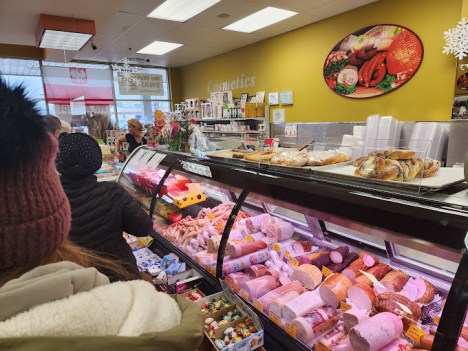
Lovely was released from the hospital this afternoon. Her cardiac doctor said she didn’t need a stress test. The nursing staff skipped both her breakfast and lunch. She was famished as was I. We left the hospital as quickly as we could, and I offered her a stop for breakfast-lunch. She said “no, we have food at home.” As we drove out of the hospital compound she told me it would be nice if we could go to the deli. She loves her European food and loves going to delis that specialize in Old Country food. I turned the car into the direction of Orland Park where Gorka is located. It is one of our favorite delis. Normally, I would wait for her while she shops, but this time I chose to go in with her. Between the two of us we filled a shopping cart with European foods and deli-meats. The bill was $105 dollars for three bags of stuff. We came home and devoured as much as we could hold. Normally, we spend about fifty dollars on this quantity of food from this deli, but with inflation a one hundred dollar bill is the new fifty.