


I published this story several years ago in a serial version. I have republished it this year as a complete story in one post. I wrote this for my young grandchildren. It is suitable for all ages. Feel free to print this and use it as a reader for your kids, or read it to them. The cartoons tell the story and the words, so just looking at the pictures gives a kid the story.
The Gift
Chapter One
Tree Farm
“There is the farm,” said Morty to himself. “Look at all those trees.”

He came to the sign: Covert Tree Farm, Christmas Trees for Sale. Morty slowed Sky-scooter and made a sharp right turn into the opening between the trees. The gravel drive wound through a grove of spruce trees. The tall trees shaded the forest floor and kept it dark. Occasionally, a bird flitted from tree to tree and sang a sweet song. A beam of sunshine peeked through. God is shining a spotlight on me, he thought. The ferns under the spotlight were lime green, surrounded by dark green in the shade.
“These twists and turns are fun,” he said to Sky. He talked to his scooter whenever he was alone. Morty steered through the forest, leaning one way, then the other. His curl swayed from side to side. He was anxious to find the perfect present for his Boss. An opening of bright light led into the meadow where the farmer lived.
He spotted the sign for parking and another sign on the barn stating rules for cutting Christmas trees.

- Cut the tree to the ground.
Please don’t cut in the middle.
2. Use only the saw provided.
3. Bring your tree to the barn for wrapping.
Trees are $20.00 per foot.

Morty grabbed a saw and jumped onto the hay wagon behind the tractor. A cow mooed, and the horse whinnied in the barn. Chickens wandered all around the barnyard, pecking for seed. He sat and looked around while he waited for the farmer.

Gosh, look at all those trees. They surround the entire pasture as far as I can see. He daydreamed as he sat waiting.
Farmer Jim raises trees. He sells some at Christmas and takes the large ones to the lumber mill in the town. He plants replacement trees to keep the forest alive. It takes fifty years to grow a tree big enough to sell for lumber and twelve years to grow a tree tall enough for Christmas.
Morty sat staring at the trees and talked to himself. I love coming to the tree farm. It is fun to explore the woods. The forest is beautiful, peaceful, quiet, and majestic. I talk to them, and they speak to me. When we are alone, I hug them.

Farmer Jim had a secret grove of old trees. He never cut these trees, nor did his father, grandfather, or great-grandfather. His great-grandfather told him they were there when he came to the farm in 1875. Some of them were two hundred feet tall. Morty discovered the grove last year and loved the old trees. His favorite was over two hundred years old. It lived through much of the history of our country. The big tree was a teenager when the first settlers moved to the valley from the east.
I have to find a tree to give to baby Jesus on his birthday. I will invite my friends to help decorate and make it memorable. The hay wagon jerked forward and broke his thoughts. He was on his way to find the perfect tree.
Chapter 2
Morty Pops the Question
Farmer Jim stopped in the field he was harvesting. Morty hopped off with the saw in his hand and began to search.
My tree has to be perfect, he thought. It has to be shapely and full of branches all around. It cannot be too big because my room is small. Morty wandered through the rows of trees. Most of them were already five to six feet tall. Many had bare spots, and deformed branches. With so many trees, picking the right one was not easy.
“They all looked perfect from the air,” he said out loud. “They looked beautiful, but they all have defects at ground level.”
He stopped in front of a Blue Spruce to ask for help.
“Please help me find the tree I need,” he said to a tree. “I want one as tall as I am, but it can’t be too broad. My tree has to be shaped like a cone without bare spots. ”
“I was exactly like that three years ago.”
“So was I,” answered another spruce.
Morty kept walking up and down row after row of trees. He finally stopped in front of a very tall Balsam tree.
“Can you help me?”

“What do you want?
“I’m looking for the perfect tree to give Jesus for Christmas.”
“I can see the tree you want from here. Follow this road next to me. Count off twenty rows, turn left, and count another five trees. There, in the center of a small clearing, you will find the tree you want.”

“Thanks,” said Morty. He took the Balsam’s directions and counted as he walked. When he reached number twenty, he turned left and counted five more. There, in the center of a small clearing, stood a beautiful blue-green spruce tree. It was perfect.

I can’t believe it, he thought. Morty was speechless. He walked around the tree, looking for bare spots; there were none.
“It is as tall as I am and shaped like a perfect cone.” He circled the tree over and over, looking and thinking, this tree will make a perfect present for Jesus. He examined the tree from all angles. He couldn’t find a single flaw.
He finally broke his silence and spoke.
“Hi, I’m Morty Angel. Would you like to be my gift to Baby Jesus?
Chapter 3
The Deal
“I’m glad to meet you,” said the little tree. “My name is Connie, which is short for Coniferous. How can I help you?
“I want you to be my gift to Jesus.”
“I can’t do that; my work is to provide a home for the birds and to shelter the rabbit that sleeps under my boughs. This summer, I had three families living in my branches. What will they do without me to shelter them?”

“The Boss will take care of them,” said Morty, “besides, there are many trees in the forest to help them. It is a great honor to do something special for Jesus’ birthday.”
“What do I have to do?”
“Let me take you home and decorate you for Christmas.”
Connie hesitated a bit, “If I choose to accept, I am giving myself to the Baby Jesus. I can only stay alive as long as the sap in my branches will hold my needles.”
“I know that,” said Morty. “I picked you because you are magnificent and want to please God’s Son. After we finish dressing you, I know you will make Jesus smile.”
“How will you decorate me?”
“I will lay strings of colorful lights on your boughs and hang ornaments to reflect the light onto your needles. My friends will string popcorn beads, painted pine cones, icicles, and snowflakes on your branches. We will put a crystal star on your top stem. You will look stunning. I’ll play Christmas carols to get into the spirit of Christmas. Then, after Christmas is over, I will use your branches to warm my house. Please do it.”
Connie agreed that pleasing Jesus on his day was important. He knew that Christmas was special. This was his chance to do something he could not do if he remained in the forest. If he stayed, he would grow big and tall and head for the sawmill.
After a long pause, Connie said, “It will be my honor to be your gift to Jesus.”
Chapter 4
Getting Home
“This won’t hurt a bit,” said Morty. He pushed and pulled the saw back and forth through Connie’s sap filled trunk in rapid motions. Seconds later, Connie fell onto the spot where the rabbit huddled at night to stay warm. The empty bird’s nest clung to his branches.
Morty saw the rabbit hiding under a nearby tree, “Well, Mr. Rabbit, come home with me. I’ll keep you warm.”
The rabbit jumped out. “Will you take care of me the way Connie did?”
“Yes,” said Morty, “come with me.” Morty hadn’t finished talking to the rabbit when the cardinal, the sparrow, and the chickadee appeared from nowhere and circled his head.
“Will you take care of us too?”
“Sure,” he said. “Come with me. We will have a great time.”
“Hold on tight, Connie. I have to drag you to the wagon.” They left a track through the snow as Morty pulled Connie behind him. They stopped in front of the tall Balsam for a rest.
“I can see that you found the perfect tree,” said Balsam.
“Yes,” said Morty, “thank you very much. I couldn’t have done it without your expert directions.”
“Have a very Merry Christmas,” replied Balsam, “I wish I could be going with you.”
Farmer Jim came and found them. He helped Morty lift Connie onto the hay wagon.

“I never thought about how I would bring a tree home on my scooter,” he said.
“Don’t worry,” said Farmer Jim, “I will help you get the tree onto your scooter. I have to help everyone who comes here. I have lots of experience with that.”
The tractor stopped in front of the shed next to the barn. Farmer Jim slid Connie into the wrapping machine and pushed the button. A big wheel started circling Connie. The noisy machine pulled the cord around the branches and squeezed them tightly into Connie’s trunk. When the noise stopped, Connie was much thinner than before.

Morty carried Connie to his scooter and just stared. He could not see how to load him. The compartment was only big enough to hold a picnic lunch and some tools. The scooter was smooth all over. It didn’t have anything sticking out to tie a rope around.

“What am I going to do?” Morty placed the tree against the side of the scooter. “Nope, that won’t work,” he said. Next, he laid Connie onto the seat. He fit nicely along the top and hanging over the end, but Morty would have to sit on top of him to drive.
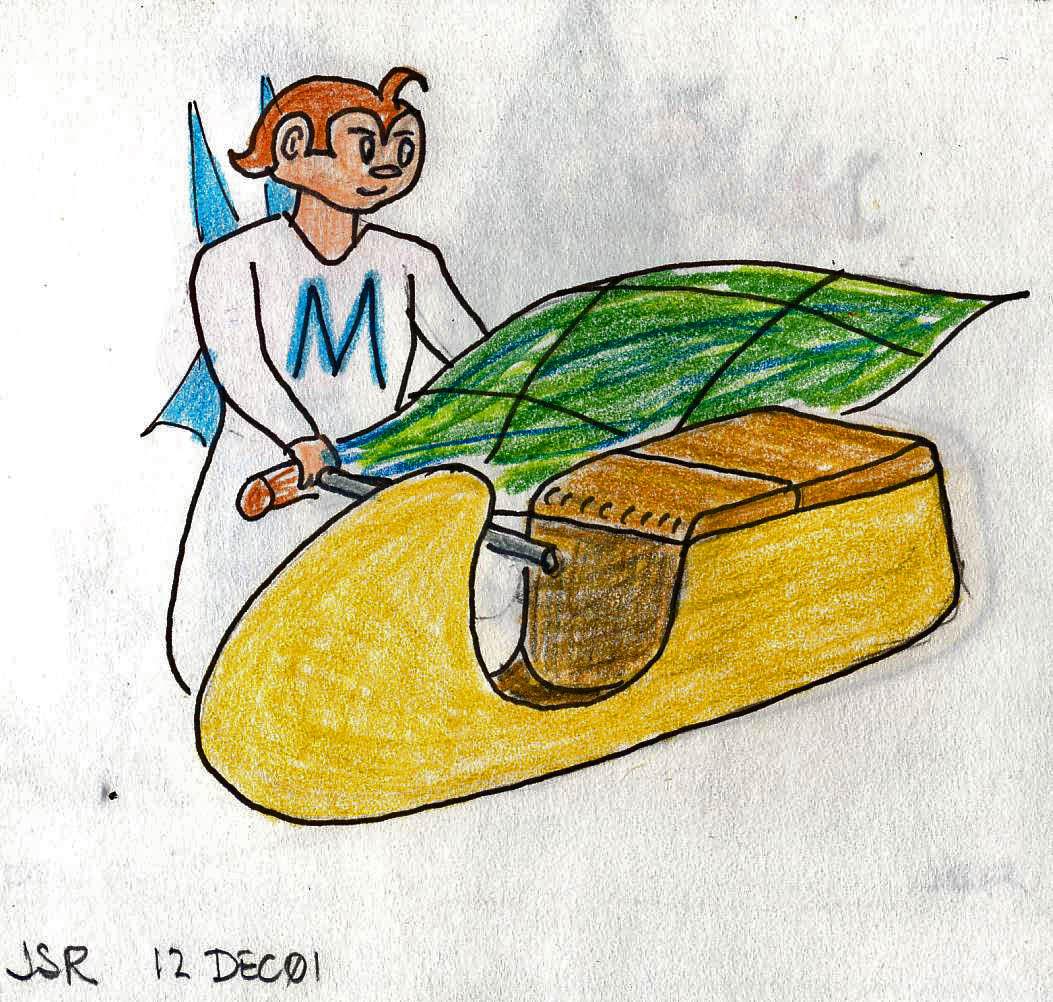
“I don’t like that either. I know. I’ll sit and hold him between my legs.” He held Connie upright between his arms. “That is worse because I can not see to drive with Connie in my face.”

Farmer Jim finally came out and tied Connie to the seat.
“You will have to sit on him,” he told Morty.”
“Okay, but I don’t like it; come on, kids, hop on.”

The bunny jumped on and huddled by his feet, and the birds found secret openings in the branches to hide in.
“I’ll go slow,” said Morty.
“Good, I don’t want you to lose me after all that fuss.”
Morty drove Sky-scooter slowly and silently. The only sound came from Connie. He was singing Happy Birthday.
Chapter 5
Reminiscing
The scoot home took a long time, and Morty deliberately kept Skye out of hyper-drive. He drove slowly to keep the little tree from tearing off. They talked as he went.
“The farmer planted me as a seed eight years ago. I became a sapling quickly and was transplanted into a new field.”
Connie jabbered away as Morty drove.
“Farmer Jim re-planted me again when I reached the sapling stage. He put me into the field where his great, great, great, great-grandfather grew up. I went thirsty during the drought, and the hot summer nearly fried my needles. I liked winter best. I loved the snow covering my boughs, which drooped to the ground.”
“I’ve been a Guardian Angel since the beginning of time,” said Morty. “I have to watch over Brad. I love watching kids the best.”
“My favorite job is to take care of birds. The Cardinals and Chickadees picked me this year. They built their nests deep in my boughs to hide it from predators. I couldn’t believe how many trips they made with string and twigs from all over the farm. Red and Rosy Cardinal brought the pieces one by one, and Rosy wove them into place. She pasted it all together with mud from the pond.”

“I loved to watch the Cardinals fly back and forth to feed their babies. They slept between meals but made a lot of noise when they woke up. The kids chirped loudly until a parent came with food. One day, a cat came into my field. Rosy covered the nest with her body and spread her wings to hide them. Red buzzed the cat’s ears to get his attention away from the babies. I dropped my boughs over the nest to give them more protection. Everything became very still while the cat was there. All the trees around me watched him stalk; his head was low, and his shoulders in a crouch. After what seemed like an eternity of stillness, the cat finally wandered off.”
Morty arrived home after dark. He untied Connie’s branches and set him upright into a bucket of water.
“Tomorrow,” he said, “I will place you into a tree stand and dress you for the birthday party. Now it is time for all of us to rest.”
Chapter 6
Decoration
Early the following day, Morty got up, brushed his teeth, combed his curl, and ate breakfast. It was time. He found the tree stand and placed it in the corner of his tiny room. Next, he put Connie into the stand and filled it with sugar water to give him strength while on duty for the party.

“I have to play Christmas carols while we decorate.” He tuned in to the Choir of Heavenly Angels over his boom box to play carols just as he promised Connie.
Morty sang with the music. He joyfully strung the lights onto each branch, making sure that the spacing was even. The rabbit and the birds helped decorate by hanging the popcorn garland. The sparrow held one end of the garland while the cardinal held it farther down the string. The Chickadee held a third spot. They flew up in unison, carrying the garland. Gently, they lowered the popcorn garland onto the branches. The beads came next. “I wish Brad were here to help,” said Morty. “His muscles would be great with the heavy beads. They are too heavy for the birds. I must drape the beads carefully to make them look pretty.”
As he worked, he hummed Silent Night, his favorite Christmas carol.
“Sing with me, Connie.”
“Si – lent night, Ho – ly night,
All is calm. All is bright.
Round yon Vir – gin Moth – er and child!
Ho – ly in – fant so ten – der and mild,
Sleep in heav – en – ly peace,
Sleep in heav – en – ly peace.”
They sang together as they worked.
“We have to finish decorating, Connie, so we can prepare for the party tonight.”
What a happy group they were. The Cardinals, Chickadee, Rabbit, and Morty were all decorating the tree for Jesus.
“One last trick,” said Morty. “Birds, please carry the crystal star and place it on Connie’s top stem.”
He had one final ornament to place on Connie.
“You can be proud, Connie. You are beautiful and will make Jesus happy on his birthday.
 .
.

Chapter 7
Final Touches
“Be careful with the tinsel, said Morty. “Hang each strand carefully. I don’t want Connie to look like the nest in the top branches.”
Morty placed a shiny gold ornament into the nest. As Red, Chick, and Spare hung the tinsel, they chirped Silent Night. When the last strand was in place, they landed on Morty’s curl and admired their creation. Connie was an outstanding gift to the Baby Jesus on His birthday. Morty turned on the lights, and Connie came to life.
“I feel so wonderful,” said Connie, “you made me look beautiful. I hope Baby Jesus likes me.”
Morty handed the rabbit a bright red cloth, “put this around the tree stand to add the final touch.” Rabbit dragged the red cloth under Connie’s boughs, where he had spent so many nights out of harm’s way, and worked the cover around the base.
“We have to put up the nativity next.” Morty pulled a small table to the tree. He wanted the nativity next to Connie, where all his friends would see it. Rabbit wiped the table clean and covered it with Morty’s best tablecloth. The birds waited nearby. Each had a figure ready to place. Morty set the stable in place.
“Okay, now you can finish by putting the figures down.”
Each bird hovered gently with a figure in its beak and lowered it to the table. They handled Mary, Joseph, Jesus, and the scene’s characters with special care and gentleness.
Morty put down the last tiny white lamb, “Here you are, little Shepard.” The nativity was complete.

Chapter 8
Birthday Party
Morty’s tiny house glowed with the tree and the nativity. The birds sang in anticipation of the party. Morty and Rabbit danced a circle around the room.
“My friends Max and Gracie are coming to celebrate,” he said. “They will be late. Gracie is with Ben, and Max is with Jenna. They must stay until the kids say their prayers and are asleep.
When the guardian angels knew their kids were dreaming of sugarplums and fairies, they slipped away to Morty’s house.
Max and Gracie arrived with their halos turned on and shining brightly. Their angel wings glowed and fluttered when they saw Connie for the first time.
“Wow, what a beautiful tree,” they said. “Jesus will love you, Connie.” “I have a new tradition to share with you,” said Morty.
“What is it?”
“It is called breaking bread.” Morty gave Max and Gracie each a slice of unleavened bread. He held his piece up and stood in front of Gracie. “Hold your bread up like I am doing.”
“Like this?”
“Yes.” Morty pinched a piece of Gracie’s bread and said, “I wish you peace.” He tore another piece and wished her love.
“Now, you do the same and make your wishes for me.”
Gracie followed his example. “What a beautiful tradition. Where did you learn this?”
“On my last visit to heaven, Brad, Ben, and Jenna’s Grandma showed me. She asked me to keep the tradition going in her family.”
The three angels shared wishes for each other. Each of them broke bread from the other and made a wish with each piece.
When the bread was all gone, they made one final wish.
“Merry Christmas.”

Without another word, Morty, Gracie, and Max knelt quietly before the crèche, the birds, and the rabbit at their sides.
They said prayers for their children, for peace in the world, and goodwill toward all men!
The End
The Gift (A Story)
Filed under: Cartoons, children's writers, family, religion, Tree of Life, Warm and Fuzzy | Tagged: Angel, Birds, Children's Story, Christmas Tree, Creche, Farmer, Guardian Angel, Jesus, Nativity, Rabbits, Tree Farm | 1 Comment »


